
Why is my front door letting cold air in?
A door has several places where a small opening can become a noticeable draft:
Along the top and sides: Weatherstripping cushions the joint between the moving door and its frame.
Across the bottom: The door sweep or bottom seal meets the threshold, the surface you step over.

A bad threshold can cause issues with drafts entering the home At the bottom corners, small gaps can remain where the side seals, sweep, and sill meet.
Around the frame: Air can travel through an unsealed space between the door frame and the surrounding wall framing, behind the decorative trim.
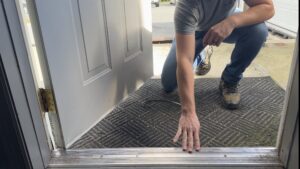
Andrew checks the fit early for a reason: weatherstripping can only seal properly when the door closes against it. A loose latch-side fit or uneven alignment can leave a gap even when the seal itself looks fine.
That is why buying thicker weatherstripping is not always the answer. The existing door may need an adjustment, a matching replacement part, or a repair somewhere less obvious.
A homeowner checklist for finding the draft
Gather a flashlight, a strip of tissue, a piece of paper, and your phone for photos. Work with the door fully closed and latched, as it normally would be. A cool, breezy day may make the problem easier to notice.
1. Notice how the door closes
Does it latch easily, or do you have to lift the handle, pull hard, or give it a shoulder? Once latched, does it still move in and out when you gently press it?
Write down what you notice. Excess movement or uneven closing gives our team a reason to check the strike plate, hinges, and door alignment before replacing seals.
2. Follow the entire edge
Slowly move your hand near the top, both sides, and bottom of the closed door. A lightweight tissue strip can help reveal moving air. Keep it away from a nearby heating register or fan so you are checking the doorway rather than room airflow.
Note whether the draft is concentrated in one spot or runs along a longer section. If you see daylight through a closed joint, photograph that spot. A flashlight and a helper can also reveal larger gaps, although smaller leaks may remain invisible.
3. Compare the seal with a piece of paper
Place paper between the door and its weatherstripping, close the door normally, and gently pull. Repeat at several points along the top and sides.
A spot where the paper slips out much more easily than elsewhere may have weak contact. Treat that as a clue, rather than a complete diagnosis. The U.S. Department of Energy includes paper and flashlight checks in its home energy assessment guide.
4. Look at the weatherstripping and bottom seal
Open the door and look for side seals that are cracked, torn, flattened, painted over, loose, or missing. Check the bottom for rubber or vinyl pieces hanging down or collecting on the floor.
Andrew shows a loose piece of door sweep in the video. That kind of visible wear gives us a specific component to inspect. Also look at both bottom corners, where a small gap can be easy to miss from standing height.
5. Look beyond the moving door
With the door closed again, check whether the cold air seems to come from the trim-to-wall area instead of the door’s edge. Note any water stains, peeling finish, rust holes, visibly deteriorated wood, or a threshold that moves under normal use.
Air leakage and water intrusion deserve separate attention. If water appears after rain, tell us when it happens and take a photo before the area dries. Adding another seal may not address the route water is taking.
6. Make a short record for the repair visit
Your notes can be as simple as:
Draft location: Top, latch side, hinge side, bottom center, bottom corner, or around the trim
When it happens: Windy weather, colder temperatures, or after rain
How the door operates: Closes normally, sticks, needs lifting, or moves when latched
Visible damage: Worn seal, loose sweep, rust, staining, or deteriorated wood
Previous repairs: What was changed and whether it helped
Those details help us understand the complaint and narrow down what to inspect. You do not need to know the name of every part of a door to request a repair.
What the location of the draft can tell us
These are starting points for an inspection, not automatic diagnoses.
| Where you notice the problem | What Joyland may need to check |
|---|---|
| Air along the latch side; the closed door has some play | Strike-plate position, latch engagement, and contact with the weatherstripping |
| A gap at the top on one side or near the bottom on the other | Hinge position, alignment, frame condition, or a warped door panel |
| Cracked or flattened seals along the sides | Weatherstripping condition, profile, and fit |
| Air or daylight at a bottom corner | The joint between weatherstripping, sweep, sill, and any manufacturer-specified corner seal |
| Air across the bottom; pieces of seal are falling off | Door sweep, threshold contact, and the condition of the sill |
| Air around the trim even after the door edges seal well | The concealed air seal between the door frame and the wall opening |
The same general repair categories appear in Therma-Tru’s door troubleshooting guidance, including damaged weatherstripping, missing corner pads, uneven fit, and excessive movement when latched. The correct part and adjustment depend on the specific door system.
How can Joyland repair a drafty door?
Our window and door repair services include work on door hardware, worn sweeps, and weatherstripping issues. Andrew’s process helps determine which repair actually addresses the complaint.
Depending on what we find, we may adjust the fit, replace a worn seal, install a compatible corner pad, or address an air leak around the frame. Putting fresh weatherstripping on a door that still closes unevenly can leave the original problem in place.
If air continues to enter around an otherwise well-sealed door, Andrew explains that the next step may be checking behind the interior casing. That is the decorative trim around the opening.
The Department of Energy’s guidance on sealing door and window openings makes a useful distinction: fibrous insulation alone does not stop airflow. The gap needs an air seal, using an appropriate material such as sealant, backer rod, or low-expansion foam designed for windows and doors.
Product selection matters. For example, window-and-door foam from Great Stuff is formulated with a low expansion pressure to prevent frame bowing when properly installed. The repair also needs to respect the door manufacturer’s installation and drainage details.
How much does drafty door repair cost?
In our September 2026 video, Andrew gives a rough range of $200–$600 for basic door repairs involving seals and adjustments. That is a useful starting point for the work he discusses, rather than a price for every door problem.
The quote depends on the cause, compatible parts, access, and labor. Repairing deteriorated framing or addressing damage hidden behind the trim can involve a different scope of work.
For perspective, here is that repair guidance beside the typical installed replacement ranges on Joyland’s door pricing page:
| Type of work | Pricing guidance | What the number represents |
|---|---|---|
| Basic seals and adjustments | About $200–$600 | Andrew’s approximate range for the basic repairs discussed in the video |
| Basic entry door replacement | $3,000–$5,000 | Joyland’s typical installed replacement range |
| Mid-range fiberglass replacement | $5,000–$8,000 | Joyland’s typical installed replacement range |
| Premium entry door with sidelights | $9,000–$12,000+ | A larger or more elaborate entry system |
Pricing guidance reviewed October 2026. These are different scopes of work, not interchangeable quotes. Door configuration and installation conditions affect the final price.
The useful question is whether the repair will give you a door that closes, locks, and seals reliably. A sound door with a worn sweep deserves a different conversation from a deteriorating door that needs another temporary fix every season.
When does replacement make more sense?
Andrew points to rusted-through metal, weakened areas, and deterioration at the bottom of a door as reasons to consider replacement.
Replacement becomes more likely when:
The door panel is rusted through, separating, or too distorted to seal reliably.
Rot affects the frame or sill enough that a limited repair would leave weak material in place.
Water damage has spread beyond the seals and trim.
The door cannot be made to close and lock properly with a reasonable repair.
Several failing components make repair poor value compared with replacing the affected assembly.
A worn threshold component does not automatically mean the entire door must go. Some systems have replaceable sill caps or saddles. Therma-Tru’s maintenance resources even include instructions for sill-cap replacement. The distinction is between a serviceable part and deterioration in the assembly beneath or around it.
Your plans matter, too. Andrew raises the question of whether a homeowner expects to stay, sell, or replace the door in the near future. Our related article on whether new doors and windows are worth it in central Pennsylvania examines those decisions through the lenses of comfort, function, appearance, and resale value.
A real Joyland example from Reading
In our Reading door replacement customer story, Phil’s older doors had become drafty and difficult to operate. Joyland replaced the back door and pass door, improving their fit and operation.
That project illustrates why the whole condition matters. Age gives us context; the combination of performance problems helps determine whether replacement is the practical choice.
Will fixing the draft lower my heating bill?
Sealing an actual air leak can reduce unwanted airflow and improve comfort near the door. The dollar savings depend on how much air was leaking, your heating costs, weather, and the rest of the house.
For broader context, ENERGY STAR reports an EPA estimate of 15% average savings on heating and cooling costs from air sealing a home and adding insulation in areas such as attics, floors over crawl spaces, and accessible rim joists in basements.
That figure covers a package of whole-home improvements. It does not predict the savings from replacing one door sweep. A more comfortable entryway is a reasonable goal; a specific percentage off your bill requires more information.
If drafts seem to be everywhere, a professional home energy assessment can help identify other sources of leakage rather than assuming the front door accounts for the entire heating bill.
Common questions about drafty doors
Why is my door still drafty after new weatherstripping?
The seal may be the wrong profile, the door may not contact it evenly, or air may be entering at the sweep, corners, or around the frame. Replacing one component will not necessarily address all of those locations. The next step is checking where the air still enters.
Should I caulk around the door?
Some stationary joints around a frame may need sealant. The moving joint between the door and frame needs a suitable flexible seal that allows normal operation. The repair needs to match the leak’s location and preserve any designed drainage paths.
Can a storm door solve the problem?
A compatible storm door can be useful, but it does not repair a damaged entry door seal or a rotted frame. Our Elizabethtown storm door customer story shows how that separate upgrade helped Louise get more light and an entryway she enjoyed using. We would still assess the main door’s condition before treating a storm door as the answer to a draft.
Can Joyland come out for a repair instead of replacing the door?
Yes. Joyland Windows & Doors offers repair services as well as replacement. Tell us where you feel the draft, how the door operates, and whether you have noticed water or visible damage. We can assess the issue and explain which options make sense for your door.
Let’s find out what your door actually needs
If your front door is letting cold air in, contact Joyland Windows & Doors about having it checked. We help homeowners in Lancaster, Lebanon, York, and the surrounding south-central Pennsylvania area understand their repair and replacement options.
We will look at how the door fits, where it is leaking, and the condition of the surrounding components. Sometimes that points to a small repair. Sometimes the door has bigger problems. Either way, you should know what we found and why we recommend the next step.